
CBD and Gut Health: Microbiome, Inflammation and Scientific Evidence

SulisLuna | Science Explained | Research Review
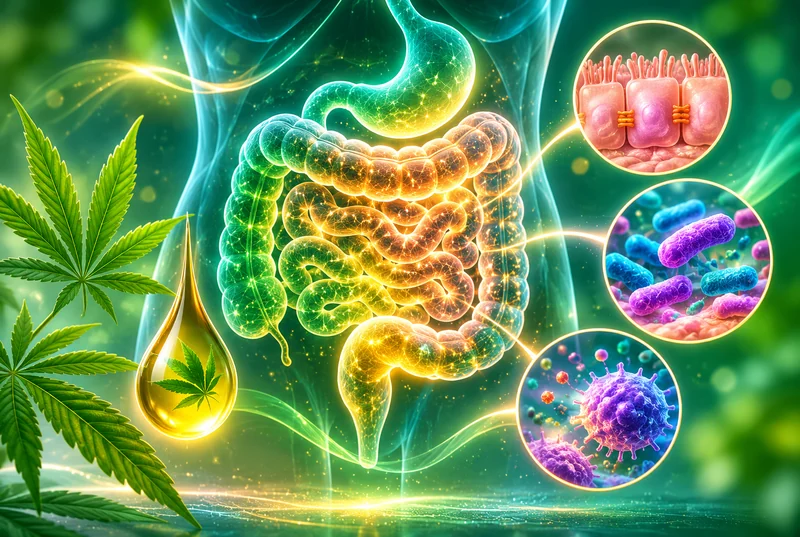
The relationship between CBD and gut health is attracting increasing scientific interest. Researchers are examining how cannabidiol may interact with the intestinal barrier, the gut microbiome and inflammatory signalling. Research on cannabidiol and gut health raises important questions about intestinal permeability, microbial composition and the regulation of inflammatory responses. But do laboratory findings translate into proven benefits for people? A 2024 scientific review published in Cells helps distinguish experimental observations from clinically established outcomes.
Key takeaway:
Studies investigating CBD and gut health
have reported changes in intestinal
permeability markers, microbial populations
and selected inflammatory indicators.
However, most findings come from
laboratory or animal studies.
Human clinical evidence remains limited,
and CBD has not been established
as an effective treatment for
intestinal diseases.
1. CBD and gut health: what does the scientific review examine?
In September 2024, Brown and colleagues published a narrative literature review entitled The Modulatory Effects and Therapeutic Potential of Cannabidiol in the Gut.
The publication examines scientific research on CBD and gut health, including molecular mechanisms, intestinal cell models, animal experiments and human clinical studies.
It is not a new clinical trial or a meta-analysis establishing therapeutic effectiveness.
The review discusses intestinal permeability, immune signalling and microbial composition, providing a scientific overview of the emerging relationship between cannabidiol and gut health.
Many findings remain experimental. Larger and better-designed clinical trials are required before firm conclusions about human digestive health can be drawn.
2. CBD and intestinal barrier: what does research suggest?
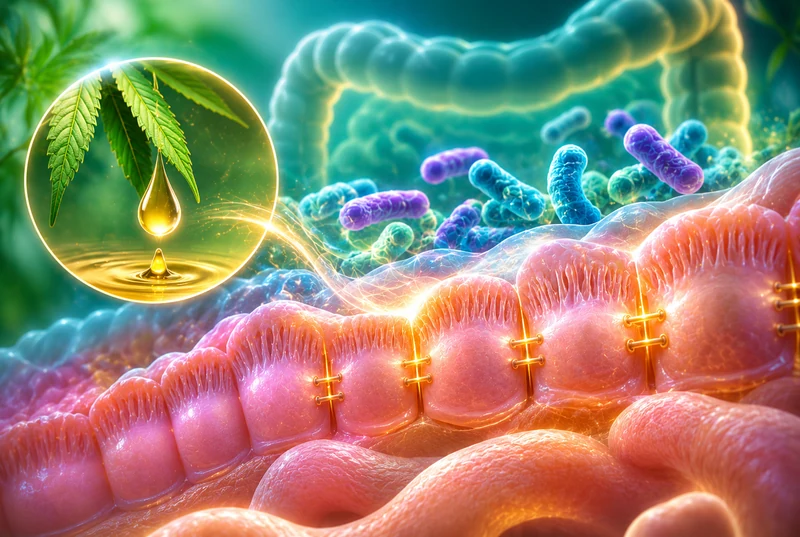
The intestinal barrier helps regulate the absorption of nutrients while limiting the passage of potentially harmful substances.
Its components include the mucus layer, intestinal epithelial cells, intercellular connections and microorganisms living in the digestive tract.
Structures known as tight junctions help regulate movement between neighbouring intestinal cells.
Research into CBD and intestinal barrier function investigates whether cannabidiol can influence selected markers of epithelial integrity and permeability.
However, changes observed in experimental models do not necessarily indicate improved intestinal barrier function in humans.
3. CBD and intestinal permeability: what do cell studies show?
Several studies discussed in the review used Caco-2 cells, a laboratory model commonly employed to investigate intestinal epithelial function.
Under specific experimental conditions, CBD was associated with changes in electrical resistance across cell layers, proteins involved in tight junctions and selected indicators of permeability and inflammatory responses.
These findings contribute to research on CBD and intestinal barrier mechanisms, but they do not demonstrate that taking CBD strengthens the human intestinal barrier.
Laboratory concentrations, formulations and experimental conditions can differ substantially from real-world exposure.
4. CBD and gut inflammation: what have animal studies found?
Some mouse models of colitis have shown reductions in selected inflammatory markers following CBD administration.
Other experiments have not demonstrated the same effects with CBD alone. In one model discussed in the review, favourable findings were reported when CBD was combined with fish oil.
Research on CBD and gut inflammation therefore presents heterogeneous results. Outcomes may depend on the disease model, dose, formulation, administration route and measurements used.
Animal studies can identify potential biological mechanisms, but they cannot establish clinical effectiveness in humans.
5. CBD and gut inflammation: what do clinical trials show?
Human research investigating CBD and gut inflammation includes small clinical studies in inflammatory bowel disease.
The review discusses trials involving Crohn's disease and ulcerative colitis. Their results require cautious interpretation.
| Condition | Participants | Intervention | Summary of findings |
|---|---|---|---|
| Crohn's disease | 19 | Oral CBD, 10 mg twice daily for eight weeks. | No statistically significant improvement in disease activity compared with placebo. |
| Ulcerative colitis | 39 | CBD-rich botanical extract over ten weeks. | Some favourable findings were reported, but the study does not establish general clinical effectiveness. |
For ulcerative colitis, the review reports that 77% of participants receiving the CBD-rich extract had disease scores classified as normal or mild, compared with 52% in the control group.
The review also describes favourable findings in selected endoscopic measures.
These observations should not be interpreted as proof that CBD treats ulcerative colitis, nor extrapolated to commercially available CBD products.
Clinical interpretation: Current evidence is insufficient to recommend CBD as a treatment for Crohn's disease, ulcerative colitis or other intestinal disorders.
6. CBD and gut microbiome: what is being investigated?
The gut microbiome includes bacteria and other microorganisms that interact with diet, the intestinal barrier and the immune system.
Research on CBD and gut microbiome interactions explores whether cannabidiol may influence the relative abundance of certain microbial groups.
The review discusses animal studies reporting changes involving specific microorganisms, including Akkermansia muciniphila in some experimental models.
However, changes in microbial composition do not automatically indicate improved digestive health.
The scientific relevance of these findings depends on the biological context and whether measurable health outcomes can be demonstrated in humans.
Current research does not establish that CBD improves the human gut microbiome.


